
Picture this. An employee opens a meditation app at lunch, takes ten deep breaths, gets back to her desk, and finds another email demanding a turnaround that isn't realistic. By 4pm the breathing exercise is forgotten and she's staying late again.
Her organisation is paying for that meditation app. They're paying for it because they care about wellbeing. The intent is good. The strategy is broken.
Most workplace wellbeing programmes are designed to help individuals cope with stress. Apps, EAPs, mindfulness sessions, gym memberships, lunchtime yoga. None of these things are bad. They are all good things, available because someone in the organisation pushed for them. The trouble is that they all treat the symptom, not the cause.
When someone is stressed at work, the question worth asking isn't "how do we help her cope". It's "why is she stressed in the first place?"
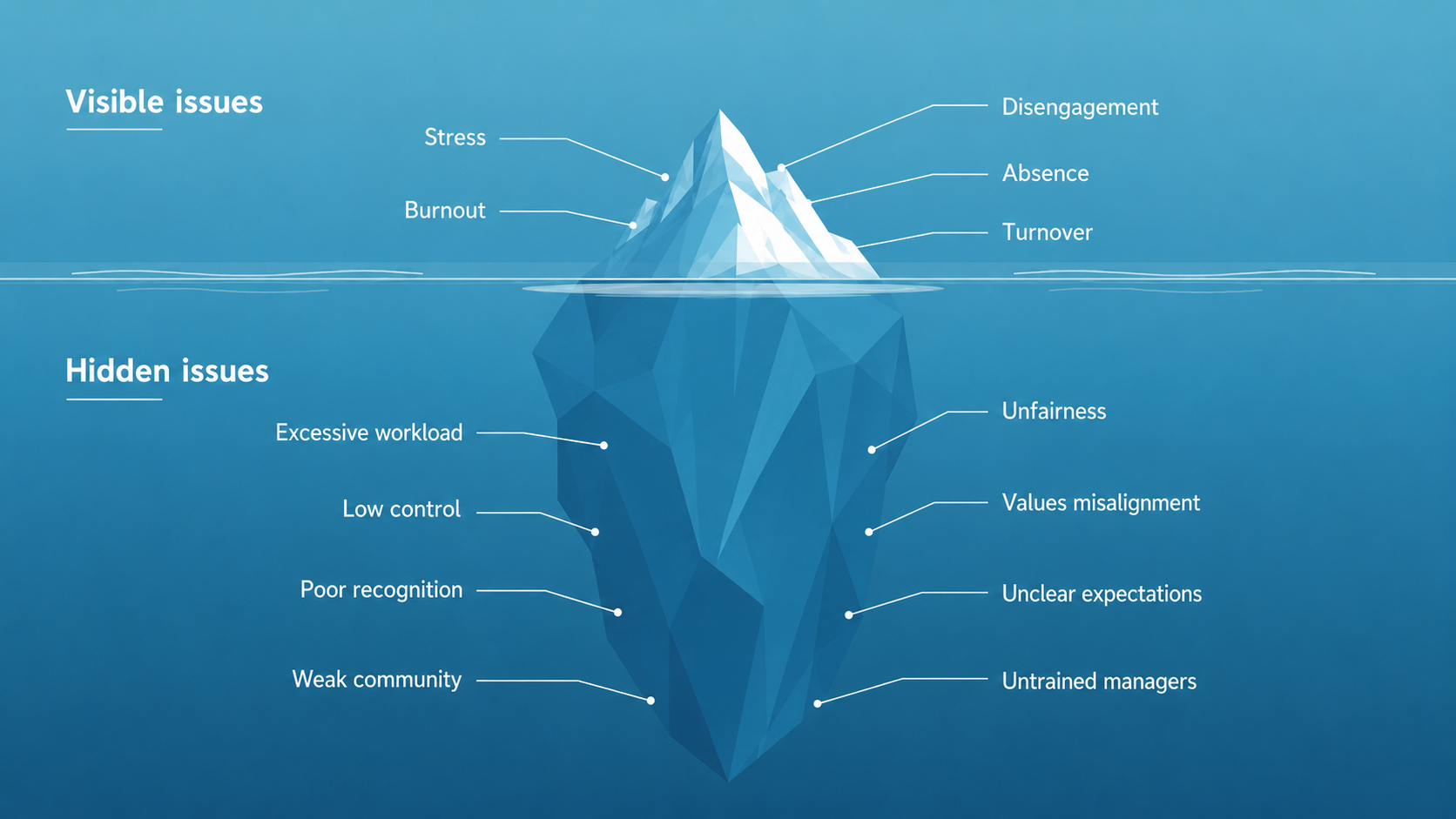
That second question is harder to ask, because the answer usually points back at the organisation. Workload that exceeds capacity. Decisions made without consultation. Unclear expectations. Reward structures that ignore the hard work going on in the background. Managers who haven't been trained for the job. Cultures that quietly punish people for raising concerns.
Researchers have been making this case for decades. Christina Maslach and Michael Leiter, two of the most-cited names in burnout research, identified six job conditions that consistently shape how people feel about work: workload, control, reward, community, fairness, and the alignment between what an organisation says it stands for and what people experience day to day. When those conditions are healthy, people generally are too. When they're not, no number of breathing apps will fix it.
The reason most organisations don't measure these conditions isn't that they don't care. It's that nobody has made it easy to measure them continuously, at scale, in a way that gives leaders something they can actually act on. Annual engagement surveys try, but by the time the data comes back, the people most affected have often already left.
That gap is what we built Occlio to close. The Vitality Pulse captures how people are actually doing at work. Alongside it, we surface the job conditions that shape those feelings - workload, fairness, recognition, the rest. Leaders see both.
That's the difference between fixing what's actually broken and treating what comes out of the cracks.
If the work environment is the thing driving the stress, the most generous wellbeing programme in the world won't move the needle. You'll spend more, your people won't get healthier, and one day someone will leave. By then it's too late.
It's worth asking, of any wellbeing initiative on your books: is this fixing what's wrong, or is it just helping people endure it for longer?
If you want to see what your organisation's wellbeing looks like underneath the surface, both symptoms and causes, join the waitlist and we'll show you what the Vitality Pulse looks like for a team like yours.